Showing posts with label Fish. Show all posts

Thursday, March 20, 2014

My Recapture Story for the Everglades

March 20, 2014 0
The following link is to an article written by Jessica Lee, FIU graduate student in Dr. Jennifer Rehage's aquatic biology lab (http://www2.fiu.edu/~rehagej/index.html).
__________________________________________________________________________
     In February I had an opportunity to fish with my favorite group of anglers from the Keys. For the past 30 years this group of fishermen has faithfully made it every month to the backcountry to fish. They were the inspiration for the Coastal Angler Science Team (CAST), the “original-members” before CAST officially came to be.  For the past two years they have been regularly scanning their catches for “recaptures” (previous fish we tagged with internal microchips, “PIT-tags”).  This group alone has caught over 30 recaptures, about half of the current CAST totals.
To read more, please go to http://cast.fiu.edu/index.php/my-recapture-story-for-the-everglades/ .

Tuesday, November 5, 2013

Flow Day!

November 05, 2013 0

Mike Bush is a guest blogger and a PhD student in the Trexler aquatic ecology lab at FIU (http://faculty.fiu.edu/~trexlerj/).
 -------------------------------------------------------------------------------------------------------------

                Everglades restoration can come in many forms, from ensuring that water heading south through the Everglades Agricultural Area is stripped of excess nutrients before it hits the more natural areas of the Everglades to shuffling around huge amounts of water under Alligator Alley into Fakahatchee Strand.
Perhaps no project is as ambitious as the Water Conservation Area 3A Decompartmentalization and Sheetflow Enhancement Project (we just refer to it as “DPM” or “Decomp” for short, thank goodness). DPM is a multifaceted project, with major involvement by the South Florida Water Management District and the US Army Corps of Engineers, that focuses on removing levees and plugging canals that are found throughout the Everglades, hence the “decompartmentalize” part. The overarching goal here is to restore sheetflow, that slow moving conveyance of water through the Everglades that inspired Marjory Stoneman Douglas’ phrase “River of Grass”. A component of DPM is the DPM Physical Model, the first step in testing how restoration of sheetflow will affect sediment and nutrient transport. This in turn could affect the plants and animals of the system, including how the ridge-and-slow structure of the Everglades is maintained or altered.

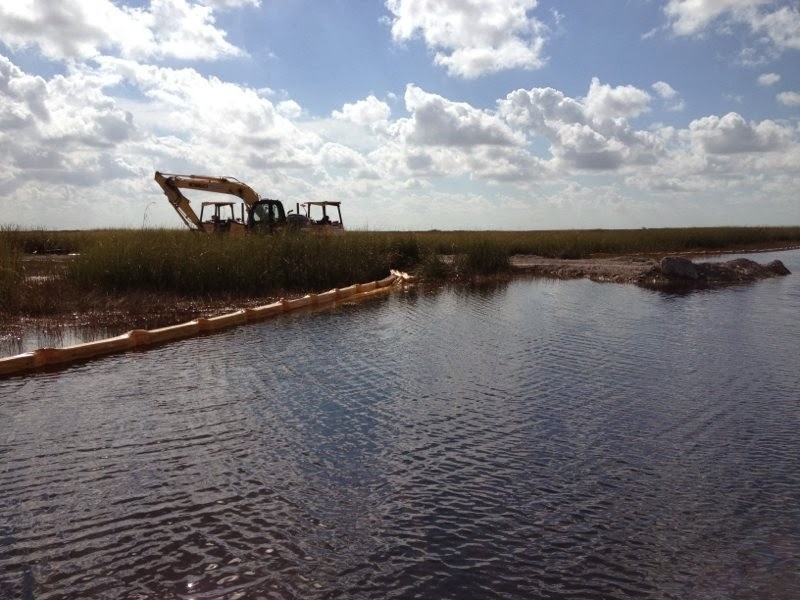
                Construction for the project about a year ago, and the lab I’m in has been collecting fish, amphibian, and aquatic invertebrate data since Fall 2010. Water is projected to flow east from a section of the Everglades known as Water Conservation Area 3A, through a series of culverts in the L67-A levee, across a roughly 1 mile section of marsh known as the “Gap” or “Pocket”, and then across the L67-C canal and levee into Water Conservation Area 3B. The C canal, where many of my field sites are, has either been filled in entirely or partially filled across the experimental zone. This will examine whether future restoration projects can get away with just partial canal fills, a much cheaper option than filling a deep canal with earth all the way to marsh level. The project is finally complete and today the culverts in the A levee were opened. Today, known to many in many agencies and institutions as “Flow Day”, is the first day in what hopes to be a great day for Everglades restoration.  I am amazed at how much manpower and collaboration goes in to trying to restore natural components of the Everglades landscape. And it’s certainly odd to spend so much time out here with no other humans (besides some very dedicated and excellent field technicians), and suddenly there’s a fleet of dump trucks and earth movers out in the middle of the Everglades! Well worth the effort though for this exciting (and necessary) project for restoration.
                I’ll post aerial photos within the next couple of weeks! Stay tuned! Photo credits go to Sabrina Schneider, one of those very excellent techs I spoke of.


Monday, September 24, 2012

Awesome research animals!

September 24, 2012 0
Good morning everyone,

This blog is a tribute to all the animals that get caught up in science. Without their help, we would know alot less about the environment and the natural resources we all love!


Lobster toupee


None of the other lobsters can tell its scientific equipment: These tags are the same as the ones I use. They send a sound pulse that can be detected by underwater equipment and are used to track movement patterns (photo courtesy of FWRI http://myfwc.com/research/saltwater/telemetry/)


Gopro shark (insert dup-step music here)


These are cameras attached to the sharks back that used to video and understand shark feeding habits. Courtesy of the Shark bay ecosystem research project and the Heithaus lab (http://www2.fiu.edu/~heithaus/SBERP/projects/tigerres.html).

Punk rocker walleye… His girlfriend’s parents are not impressed


Lip tags are used in mark recapture studies. A fish gets a lip ring with a unique number and released back into the wild… When the fish is recaptured scientists are able to measure growth rates and collect movement data on that fish (http://www.flickr.com/photos/dorsal-fin/7952702836/).


Sometimes fish get tattoos… 


These are elastomer tags. These tags are dye that scientists inject under fishes skin. Since this tagging method is not invasive and the tag is not bulky, using elastomer tags often is often preferred in small fish studies…. (They also glow in the dark; http://www.nmt.us/products/vie/vie.shtml)


Psychic seal!


A satellite tag glued to an elephant seal is used to track their movements. These tags can also record water depth and temperature. Data produced from these tags  are now being used to improve maps of the arctic seafloor!  http://www.underwatertimes.com/news.php?article_id=53081461092

 
Its kind of like Jaws with the oil drums…….. but a lot more mellow  


Manatees in the Bahamas fitted with floating satellite tags.
http://www.savethemanatee.org/tracking_manatees.htm
 

Are you more or less terrified if a shark swims at you with an antenna on its fin?


Shark fitted with a satellite tag used to understand shark movement patterns.
http://www.southernfriedscience.com/?p=9449


Alligator taking a hike


An American alligator with a GPS tracker. 
http://www.al.com/sports/index.ssf/2011/05/tag_shes_it_health_of_gators_d.html


Tagging surgeries in a more relaxed setting


A red grouper getting fitted with an acoustic tag underwater in the dry Tortugas. Florida fish and wildlife Research Institute do these surgeries underwater because of the water depth that grouper reside.  Grouper can occupy deep water where atmospheric pressure is more intense, compressing air inside the fishes body. If grouper are brought to the surface too quickly, air in their body cavities will expand before they can eject it; causing the fish major stress. (photo courtesy of FWRI http://myfwc.com/research/saltwater/telemetry/)


"Geeze I already gave you my lunch, can you PLEASE untie me from the picnic table"


An American Alligator prepped for gastric lavage and tagging. This process is explained in Adam's post (photo courtesy of FCE LTER; http://www.lternet.edu/research/keyfindings/food-webs)


 Easter Mice


I swear this is a real thing. Utah  Biologists dip rodents in florescent powder. Let them go, and follow them  by looking for the powder trails. Besides looking cooler than other mice, the powder is perfectly harmless! (http://www.newswise.com/articles/powdered-rodents-show-big-old-mice-spread-hantavirus)


The rat that everybody wants to have scurrying around their house


key largo woodrat
http://www.wec.ufl.edu/faculty/mccleery/


 Find that tag!

 
A conch with an acoustic tag (photo courtesy of FWRI http://myfwc.com/research/saltwater/telemetry/)


The crayfish mullet


 Business in the front, party in the back! Slough crayfish with radio transmitters glued to their back. The wire is the antennae and the block is the battery pack (photo from Cline et al. 2012 INTECOL oral presentation and; http://www.dailymail.co.uk/sciencetech/article-2080204/Plague-bearing-crayfish-electronically-tagged-escaping-London-aquarium-taking-river.html)

 Party Crab


Christmas island crab with a radio transmitter attached to its back. These transmitters send radiowaves that can be picked up by hand held antenna like Mike Bush uses in bass. The tag also functions as a strobe light in case you want to bring the crab to a party (http://www.arkive.org/christmas-island-red-crab/gecarcoidea-natalis/image-G78977.html)