Showing posts with label Everglades restoration. Show all posts

Thursday, June 22, 2017

Diatom of the Month – June 2017: Fragilaria synegrotesca

June 22, 2017 0
by Nick Schulte*

I think Fragilaria synegrotesca is a cute diatom. Although long and lanky (nothing wrong with that!), F. synegrotesca has an adorable, sometimes very slight, potbelly (Fig. 1). 


Fig. 1. a) Live frustules in a rosette colony (http://fcelter.fiu.edu/data/database/diatom/index.htm?species=3568) 
b) Fragilaria synegrotesca in valve view (Schulte 2014).

Now, some boring diatomist (e.g., me) might describe that little bump in the middle right as “a unilaterally expanded, hyaline central margin” and that’s accurate enough. But I also like to think of it as F. synegrotesca’s belly pooch. It brings to my mind the potbellies of seahorses, pigs, puppies and toddlers, and it seems very boop-able.


But let’s move past the physical attributes of this diatom, as the allure of this species is in its “actions”. Fragilaria synegrotesca has so far only been reported from karstic wetlands of the Caribbean and is most well-known from the Florida Everglades. In the Everglades, F. synegrotesca is nearly ubiquitous (Fig. 2), and it’s one of the five most abundant species in the calcareous periphyton mats in the nutrient-poor freshwater marshes (Gaiser et al. 2006). 

Fig. 2. Relative abundance (%) of F. synegrotesca across the Everglades (data from the Comprehensive Everglades Restoration Plan Monitoring and Assessment Plan).


A major issue in Everglades restoration is getting the amounts of water and nutrients that enter this wetland right. Every winter/spring (the “dry season”), sloughs and inundated prairies often dry down. This happens more often and more severely now than in the “natural” pre-drainage state in many sites. But water managers (e.g., the South Florida Water Management District) can’t just send water through the marshes unless it’s “clean” (e.g., low in phosphorus), so as not to harm organisms that are adapted to this wetland’s low nutrient waters. So, Everglades restoration is between a bit of a rock and a hard place: we need to deliver more water to help the organisms that need high water (and can’t handle severe dry-down – e.g., many fish), but not at the expense of the organisms that can’t handle high nutrients in the water (e.g., some grasses and sedges).

Fragilaria synegrotesca is one of those organisms that doesn’t like to be dried out (Gottlieb et al. 2005, Lee et al. 2013), and its preference for being wet makes it a potentially “reliable indicator of the absence of periodic drying” in the ‘Glades (Gaiser et al. 2011). We can therefore use the abundance of this species (alongside other indicators) to measure the effects on biodiversity that potential reduced water flow might have upon different locations. This information can then inform decisions on how much water should be sent where and when – all key questions in Everglades restoration.
Unlike its freshwater-loving, high nutrient-hating buddies Brachysira microcephala, Encyonema evergladianum, and Mastogloia calcarea (let’s call them the “Fresh Diatoms of Belle Glades,” or “Freshies” for short), F. synegrotesca can also live comfortably in moderate phosphorus (P) concentrations and slightly salty water (“oligohaline”).

So, we can think of F. synegrotesca as that close friend that is too cool for us sometimes and likes to hang out with hipper, more indulgent folks.


And if this diatom is found in relatively high abundance in the absence of the Freshies, we know that area might be getting a little too phosphorus-y and/or salty than is normal. Now, there are some regions of the Everglades where finding F. synegrotescain enriched or salty places is normal, but by now we know which places are “normally” enriched/salty and which are not. So, if we see this species hanging out with the Salty Boys or the +P Posse in the good side of town (i.e., a normally freshwater, low nutrient place), we know something’s about to go down. In this way, I guess F. synegrotesca is also like that sweet suburban kid who gets caught up in the wrong crowd, and we’d rather see it back at home with the Freshies.

But here is some science to back up these potentially confusing analogies. In the Everglades, the total phosphorus (TP) optimum of F. synegrotesca is 270±202 µg P g-1periphtyon (Gaiser et al. 2006), and this species has been designated as an indicator of high TP (La Hée and Gaiser 2012). Compare that to oligotrophic, freshwater indicators (B. microcephala, E. evergladianum, and M. calcarea) that have a mean TP optimum of 159 µg g-1 (Gaiser et al. 2006). Our diatom of the month also has a salinity optimum and tolerance of 5±7.3 ppt (parts per thousand) – slightly higher than the Freshies (mean optimum across those 3 taxa = 2.9 ppt) (Wachnicka et al. 2010). Importantly, though, F. synegrotesca is generally not an indicator of a nutrient or salinity impacted site. Rather, its presence might indicate that a place is in limbo: it’s not too far gone, but it’s worse than we would expect if everything was OK. And F. synegrotesca alone doesn’t tell us much: rather, we have to look at the entire community of diatoms (and other algae and cyanobacteria) in order to make sense of the ecological impacts of modified nutrient levels and hydrology. So we use an “indicator community” analysis approach rather than “indicator species.”

As an example, in the Comprehensive Everglades Restoration Plan (CERP) Monitoring and Assessment Program (MAP) scientists from the Gaiser and Trexler labs report on how ~150 sites across the Everglades (and their animals, plants, and algae in periphyton mats) are affected by nutrient enrichment. To do this, one of the best measurements of site alteration is a combined periphyton TP-diatom community composition metric (RECOVER 2014, see pages 6-33 – 6-39). They use a “stoplight” reporting technique: green means baseline (“success”) conditions (TP < 200 µg / g), yellow means “caution” (TP = 200-250 µg / g), and red means “altered” (TP > 250 µg / g) (Fig. 3). Fragilaria synegrotesca is one of the diatoms that can contribute to a “caution” designation if it’s found away from the Freshies.


Fig. 3. Condition status of sampling sites from 2011 using a periphtyon TP-diatom community metric (from RECOVER 2014; Fig. 6-17).

So, while F. synegrotesca may seem a bit pudgy, it is a mover and shaker of the diatom scene in the Everglades. In the Everglades, there is the potential for more widespread dry-downs, human-caused phosphorus enrichment in the Everglades interior (particularly in the northern Everglades and near canals), and for sea-level rise in the southern Everglades (pushing saltier, nutrient-enriched water into the freshwater inland regions). Fragilaria synegrotesca and its associated community are great tools to understand how such disturbances are affecting the nature of this wonderful and important wetland. The ongoing diligent scientific monitoring and analysis (e.g., by CERP MAP and the Florida Coastal Everglades Long Term Ecological Research program) allow us to understand things like a potbellied diatom that inform sustainable management and conservation of the entire ecosystem.


*Ph.D. student at the Institute of Arctic and Alpine Research, University of Colorado Boulder and FIU Algae Research Lab alumnus


Gaiser, E. E., Childers, D. L., Jones, R. D., Richards, J. H., Scinto, L. J., & Trexler, J. C. (2006). Periphyton responses to eutrophication in the Florida Everglades: Crosssystem patterns of structural and compositional change. Limnology and Oceanography, 51(1part2), 617-630.

Gaiser, E. E., McCormick, P. V., Hagerthey, S. E., & Gottlieb, A. D. (2011). Landscape patterns of periphyton in the Florida Everglades. Critical Reviews in Environmental Science and Technology, 41(S1), 92-120.

Gottlieb, A., Richards, J., & Gaiser, E. (2005). Effects of desiccation duration on the community structure and nutrient retention of short and long-hydroperiod Everglades periphyton mats. Aquatic Botany, 82(2), 99-112.

Lee, S. S., Gaiser, E. E., & Trexler, J. C. (2013). Diatom-based models for inferring hydrology and periphyton abundance in a subtropical karstic wetland: Implications for ecosystem-scale bioassessment. Wetlands, 33(1), 157-173.

RECOVER (2014). System Status Report. Comprehensive Everglades Restoration Plan, Restoration Coordination and Verification (RECOVER). U.S. Army Corps of Engineers Jacksonville District, Jacksonville, Florida, and South Florida Water Management District, West Palm Beach, Florida, USA. http://141.232.10.32/pm/ssr_2014/cerp_ssr_2014.aspx

Schulte, N. (2014). Fragilaria synegrotesca. In Diatoms of the United States. Retrieved June 16, 2017, from http://westerndiatoms.colorado.edu/taxa/species/fragilaria_synegrotesca

Wachnicka, A., Gaiser, E., Collins, L., Frankovich, T., & Boyer, J. (2010). Distribution of diatoms and development of diatom-based models for inferring salinity and nutrient concentrations in Florida Bay and adjacent coastal wetlands of south Florida (USA). Estuaries and Coasts, 33(5), 1080-1098.

Wednesday, April 20, 2016

Diatom of the month – April 2016: Cocconeis placentula

April 20, 2016 0
by Luca Marazzi*

‘Who’ is it and where does it live?

This diatom is monoraphid, that is to say it has a raphe only on one valve, as shown in the figures. Monoraphid species are one of 9 major morphological types of diatoms - the other ones are: centric (like Cyclotella meneghiniana), araphid (e.g. Asterionella formosa, which forms star-shaped colonies!), eunotioid (e.g. the beautifully ornamented Eunotia diadema), symmetrical biraphid (e.g. the slender Navicula lanceolata), asymmetrical biraphid (e.g. Gomphonema parvulum), epithemioid (e.g. Rhopalodia gibba, which hosts nitrogen-fixing bacteria as symbionts), nitzschioid (e.g. the organic pollution-loving Nitzschia palea), and surirelloid (the big Surirella ovalis)1. Like in many other cases, the taxonomy is far from settled though; following recent research, numerous specimens usually named C. placentula should be more accurately named Cocconeis lineata and C. euglypta2.

                                          
 Cocconeis placentula / C. lineata from a 2003 Everglades sample (Dr. Evelyn Gaiser Lab photo archive). 


 Valve with (left) and without (right) raphe (http://westerndiatoms.colorado.edu/; scalebar: 10 µm). Recent taxonomic work suggests that this be named C. euglypta (pers. comm. Tom Frankovich)2.

Like many other diatoms that are adapted to specific environmental conditions, Cocconeis placentula, is a freshwater epiphytic species that tolerates high salinity levels in the water. Why? A 2013 study on the Coroong wetlands (Australia) suggests that this diatom (and C. pinnata) is capable of regulating the size of its pore holes which control nutrient flows between the cells and the environment3. With higher concentrations of salt, this diatom basically spits out the ions in excess from aptly enlarged pores.

Why are we studying it?

Algae such as our diatoms of the month are extremely useful indicators or sentinels of the environmental changes occurring in freshwater ecosystems, including (as by now you know, if you read previous posts) the Florida Everglades. A recent study on sediment cores collected in this wetland’s marshes identified several species best adapted to shallow habitats with short hydroperiod (the number of days during which a site is flooded / wet), e.g. Nitzschia serpentiraphe, Achnanthidium minutissimum, and C. placentula, that were most abundant in shallow water / short hydroperiod habitats (<38 cm; <300 days), as opposed to deeper water / long hydroperiod habitats (>46 cm; >400 days), which were preferred by other taxa such as Eunotia flexuosa and Encyonema evergladianum4. So data on these microalgae, together with key hydrological and water quality information, can improve our understanding of the effects of water flow changes in the Everglades. The impacts of large-scale canalizations and water retention schemes - to respectively irrigate crops and protect cities from either floods or droughts – on the ecosystem – and that of restoration projects to enhance water flow to natural areas have been monitored for many years. Measuring and estimating past and present environmental conditions is crucial to provide South Florida water managers and state and federal agency policy makers with realistic scenarios of what the marshes and prairies will look like in the years to come, subject to different natural conditions and human choices. These models are then used by organizations such as the South Florida Water Management District, and the US Army Corps of Engineers, for example to increase the important flows of freshwater to Everglades National Park (“The largest subtropical wilderness in the United States”).


 Faculty and staff members of FIU, South Florida Water Management District, and US Army Corps of Engineers near a large tree island during an official visit to Water Conservation Area 3A (November 2015).


* Postdoctoral Associate in Dr. Evelyn Gaiser's lab at Florida International University.

1. Source: http://westerndiatoms.colorado.edu/taxa
2. Romero O.E., Jahn R. (2013) Typification of Cocconeis lineata and Cocconeis euglypta. Diatom Research,
    28, 175–184. 
3. Leterme S.C., Prime E., Mitchell J., Brown M.H., Ellis A.V. Diatom adaptability to environmental change: a case study   of two Cocconeis species from high-salinity areas. Diatom Research, 28, 29–35.
4. Sanchez C., Gaiser E.E., Saunders C.J., Wachnicka A.H., Oehm N., Craft C. (2013) Challenges in using siliceous subfossils as a tool for inferring past water level and hydroperiod in Everglades marshes. Journal of Paleolimnology, 49, 45–66.

Wednesday, January 14, 2015

Algae Met a Bear: Algae where you'd least expect them!

January 14, 2015 0
Polar bear! In the EVERGLADES?!?!
So how many of you know the poem "Algy"?

"Algy met a bear.
The bear met Algy.
The bear was bulgy.
The bulge was Algy."


I think my dad sang "Algy" to me when I was a little tyke, though in my 3-year-old wisdom I must have taken "Algy" as "Algae" and from then on aspired to become a phycologist. Now, some attribute this verse to Ogden Nash, while others chalk it up to Anonymous (that great and varied writer!). And while this verse may be humorous, it's not truly nonsense (though this sentence is). I've seen analysis of Algy and the bear as an allegory for existentialist being (what does it mean "to be"?), while others just say (spoiler alert) that the bear ate Algy. BUT, I think they're all wrong as a result of a translational error where "Algy" should be "Algae" as my 3-year-old self clearly realized. THEREFORE:

Looks a little green 'round the edges.
"Algae met a bear.
The bear met algae."

These lines are clearly discussing the cyanobacteria that grow in polar bear hair fibers! That's right - there's a type of cyanobacteria (blue-green algae) that lives in the hollow hairs of polar bears. This isn't a natural phenomenon, as the cold habitat of polar bears prevents algae from normally colonizing polar bear fur, but in warmer zoos algae find the hair follicles of the bears a cozy place to set up shop (and turn the polar bears what some think is a sickly "green around the edges").

"The bear was bulgy.
The bulge was algae."

All pictures are a different scale: 1. Polar bear hair (tiny dots are the algae), 2. Close-up of the tiny Aphanocapsa dots, 3. Super close-up of Aphanocapsa montana, aka "the bulge". From Lewin et al. 1981.
These lines are, likewise, clearly categorizing the specific type of the cyanobacteria in those hairs. Lewin et al. in 1981 found that the algae living in polar bear hair were cyanobacteria of the order Chroococcales, resembling the species Aphanocapsa montana. Individuals of this species are unicellular and spherical, described as globules and gelatinous. I think Anonymous added "bulgy" to that description!

Glad we cleared that up.

But from here we can go completely crazy. You know that greenish tinge of sloths? Algae. (This one's really quite cool, too. Sloth hairs have cracks that allow rain to saturate the follicle, which in turn allows algae to grow hydroponically - in this case a green alga named Trichophilus welckeri is most common.

There's a really quite hilarious and informative recent study by Pauli et al. 2014 and article that summarizes a very "crappy" pathway among sloths, moths, and algae - check it out and impress your friends! Make that one sloth-obsessive think twice about that love for adorable sloths. And even a new genus and species of red has been described from sloth hair!)
Cute obligatory sea otter.

I think I also promised a picture of a sea otter. You know what? Algae in their hair, too.

And if we look beyond hair, we see all sorts of epizoic algae (algae growing on animals): on shells, turtles, lizards, manatees! Moral of the story? Wash your hair. Algae are here to take over the world.

Oh? You don't see the relevance of this to graduate research in the Everglades? Well, I could attribute this to the strain of my M.S. research finally getting to me, propelling me into babbling analysis of children rhymes and my research project (I wonder if I could squeeze this into a chapter of interdisciplinary applications of the research...). But, really, I was thinking up ways of introducing those that need no introduction: ALGAE! Pop quiz for name recognition:

Agar, biofuels, harmful algal blooms, ice cream, Naked Juice, nori, oxygen, Spirulina.

This author's personal favorite. And,
yes, it does have carrageenan.
And apparently half the fat. Tasty algae.
If any of those sound familiar, you've likely come across algae in some way or another, either as a product using some algae extract (e.g., carrageenan, a thickening agent, is used in many ice creams and is extracted from the red alga Chondrus crispus) or some other basic function (e.g., algae produce over half of the oxygen in the atmosphere!). Sylvia Lee's already written about "What is algae?" so I won't elaborate beyond "the bulge" (as above). But, instead, what's the big deal about algae in the Everglades? Well, you're going to have to stay tuned for next week's (?) episode of Nick's Wonderful World of Algae. I see you all waiting as eagerly for it as for new episodes of The Walking Dead or Game of Thrones, etc. But what about The Walking Algae or Game of Cyanos?

A teaser: I mentioned algae on manatees. Dr. Tom Frankovich from FIU has actually looked into diatoms that live on manatees 'round these parts - super cool stuff. You may have noticed manatees that look a bit mossy. Let's amend that to "algae-y" and start singing, "Algae met a manatee. The manatee met algae." And they lived happily ever after.
D'aww. From: Fish and Wildlife Service

Tuesday, December 10, 2013

Carbon dynamics from reconstructed (LILA) tree islands in the Everglades

December 10, 2013 0
 This post was written by guest blogger Alexandra Serna, a post-doctoral researcher in the FIU Freshwater Biogeochemistry Lab (http://www2.fiu.edu/~fwbgchem/), about some of her work on tree islands and carbon dynamics in the Everglades.
 ___________________________________________________________________________


A few weeks ago, I attended the American Society of Agronomy, Crop Science Society of America, and Soil Science Society of America Annual Meetings in Tampa, FL. What a huge conference! My colleagues and I presented our most recent data on tree island Carbon (C) dynamics. Tree islands are one of the most prominent landscape features of the Everglades system.
Despite their importance, hydrologic modifications to the system have greatly altered the number, size, and distribution of tree islands in the Everglades. The original peat-accreting system stored large quantities of soil C and was a sink for atmospheric CO2. Hydrologic manipulation and wide-spread drainage have caused the oxidation, subsidence, and loss of large quantities of soil C. An important aspect of the Everglades ecosystem restoration is an attempt to reestablish a more natural hydrology. Increased freshwater flows through the Greater Everglades Ecosystem (GEE) are expected as a result of projects planned to enhance water delivery. However, the degree to which changes in water delivery will affect the tree islands is uncertain.Our work provides a before-intervention study conducted in the Loxahatchee Impoundment Landscape Assessment (LILA) facility (Boynton Beach, Florida). LILA is a research platform that supports the LTER project by defining hydrologic regimes that contribute to the preservation of existing tree island and potential mechanisms for tree island restoration/creation. LILA consists of four macrocosms, that mimic Everglades ridge, slough and tree island landscape structure. LILA exemplifies the tree islands found in the GEE and across the FCE-LTER landscape by having two types of constructed tree islands; those
where peat soils were sculpted to create topographic high, or where limestone cores were established and then covered to the same final elevations as the peat islands. These two core types are meant to represent tree islands from the northern and southern Everglades, respectively.
The objective of our work is to study vegetation and water flow interactions and how they influence C dynamics of Everglades tree islands. We developed an empirically-based model for tree island soil based on production and decomposition of organic matter as influenced by water depth fluctuations. Soil respiration (CO2 efflux), litter (organic matter) production, soil accretion (C sequestration) and soil elevation change measurements were balanced in two types of LILA tree islands (peat or limestone cores) at different water depth (high and low elevation). The higher elevations (drier) of the tree islands generally had higher biomass, litter production, and soil accretion. Peat core islands favor a more productive tree island plant community, but peat islands tend to subside more rapidly than limestone islands. In the peat islands and at higher elevations, trees were maximally productive. The centers of the tree islands seem to be losing elevation despite the fact that soil is being accreted at the greatest rate in these locations. There are several possible reasons for the loss in elevation, including root decomposition, sediment compaction since tree island creation, and groundwater withdrawal. Higher rates of CO2 efflux (i.e., soil respiration) occurred in the head of the tree islands at high elevation, coinciding with higher litter production and biomass. To date, our work has shown that production and soil accretion in relatively young (~6 years old) LILA tree islands do not build topography at a rate to compete with settling/subsidence.
Overall, there was an effect of both water depth and island core type on C inputs/outputs. Carbon balance estimates to date have been made on young LILA tree islands at preliminary stages of formation. These mechanisms (e.g., litterfall leading to soil accretion) are developing and it is expected that further development will change estimates of C dynamics. Our research helped to balance present-day C inputs/outputs in the altered Everglades ecosystem. Understanding how Everglades tree islands soil respiration responds to water depth fluctuations coupled with organic matter production and soil accretion can be used by managers to slow or reverse tree island loss. Carbon cycling has always been and continues to be a primary research goal in the FCE-LTER Program.
The meeting was an excellent opportunity to discuss experiences with other scientists with similar interests and to get constructive feedback from experts in the field. I thank the FCE LTER for partially funding my trip through the 2013 LTER Student Travel Award for post docs and technicians. It gave me the opportunity to present our work and also meeting not only established members of the scientific community, but experts from the industry and consulting sectors.

Tuesday, November 5, 2013

Flow Day!

November 05, 2013 0

Mike Bush is a guest blogger and a PhD student in the Trexler aquatic ecology lab at FIU (http://faculty.fiu.edu/~trexlerj/).
 -------------------------------------------------------------------------------------------------------------

                Everglades restoration can come in many forms, from ensuring that water heading south through the Everglades Agricultural Area is stripped of excess nutrients before it hits the more natural areas of the Everglades to shuffling around huge amounts of water under Alligator Alley into Fakahatchee Strand.
Perhaps no project is as ambitious as the Water Conservation Area 3A Decompartmentalization and Sheetflow Enhancement Project (we just refer to it as “DPM” or “Decomp” for short, thank goodness). DPM is a multifaceted project, with major involvement by the South Florida Water Management District and the US Army Corps of Engineers, that focuses on removing levees and plugging canals that are found throughout the Everglades, hence the “decompartmentalize” part. The overarching goal here is to restore sheetflow, that slow moving conveyance of water through the Everglades that inspired Marjory Stoneman Douglas’ phrase “River of Grass”. A component of DPM is the DPM Physical Model, the first step in testing how restoration of sheetflow will affect sediment and nutrient transport. This in turn could affect the plants and animals of the system, including how the ridge-and-slow structure of the Everglades is maintained or altered.

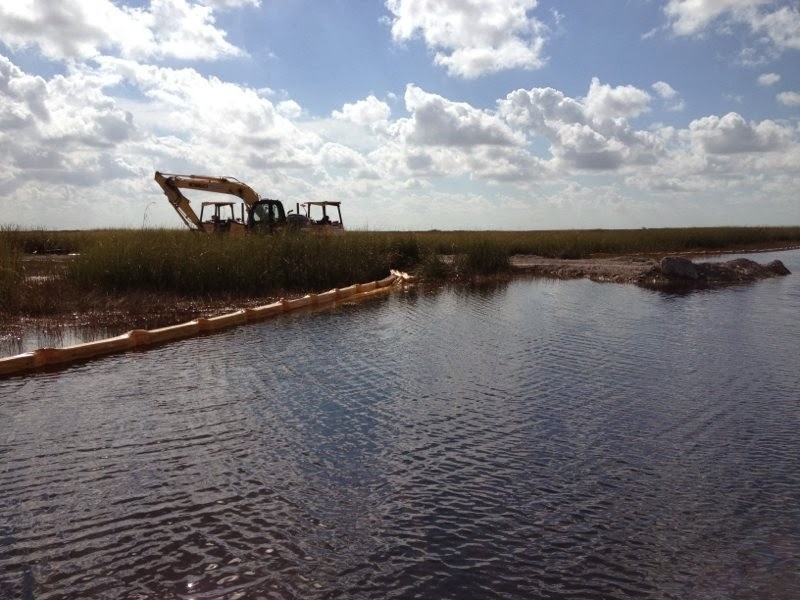
                Construction for the project about a year ago, and the lab I’m in has been collecting fish, amphibian, and aquatic invertebrate data since Fall 2010. Water is projected to flow east from a section of the Everglades known as Water Conservation Area 3A, through a series of culverts in the L67-A levee, across a roughly 1 mile section of marsh known as the “Gap” or “Pocket”, and then across the L67-C canal and levee into Water Conservation Area 3B. The C canal, where many of my field sites are, has either been filled in entirely or partially filled across the experimental zone. This will examine whether future restoration projects can get away with just partial canal fills, a much cheaper option than filling a deep canal with earth all the way to marsh level. The project is finally complete and today the culverts in the A levee were opened. Today, known to many in many agencies and institutions as “Flow Day”, is the first day in what hopes to be a great day for Everglades restoration.  I am amazed at how much manpower and collaboration goes in to trying to restore natural components of the Everglades landscape. And it’s certainly odd to spend so much time out here with no other humans (besides some very dedicated and excellent field technicians), and suddenly there’s a fleet of dump trucks and earth movers out in the middle of the Everglades! Well worth the effort though for this exciting (and necessary) project for restoration.
                I’ll post aerial photos within the next couple of weeks! Stay tuned! Photo credits go to Sabrina Schneider, one of those very excellent techs I spoke of.