Showing posts with label Habitat Shifts. Show all posts

Tuesday, November 5, 2013

Flow Day!

November 05, 2013 0

Mike Bush is a guest blogger and a PhD student in the Trexler aquatic ecology lab at FIU (http://faculty.fiu.edu/~trexlerj/).
 -------------------------------------------------------------------------------------------------------------

                Everglades restoration can come in many forms, from ensuring that water heading south through the Everglades Agricultural Area is stripped of excess nutrients before it hits the more natural areas of the Everglades to shuffling around huge amounts of water under Alligator Alley into Fakahatchee Strand.
Perhaps no project is as ambitious as the Water Conservation Area 3A Decompartmentalization and Sheetflow Enhancement Project (we just refer to it as “DPM” or “Decomp” for short, thank goodness). DPM is a multifaceted project, with major involvement by the South Florida Water Management District and the US Army Corps of Engineers, that focuses on removing levees and plugging canals that are found throughout the Everglades, hence the “decompartmentalize” part. The overarching goal here is to restore sheetflow, that slow moving conveyance of water through the Everglades that inspired Marjory Stoneman Douglas’ phrase “River of Grass”. A component of DPM is the DPM Physical Model, the first step in testing how restoration of sheetflow will affect sediment and nutrient transport. This in turn could affect the plants and animals of the system, including how the ridge-and-slow structure of the Everglades is maintained or altered.

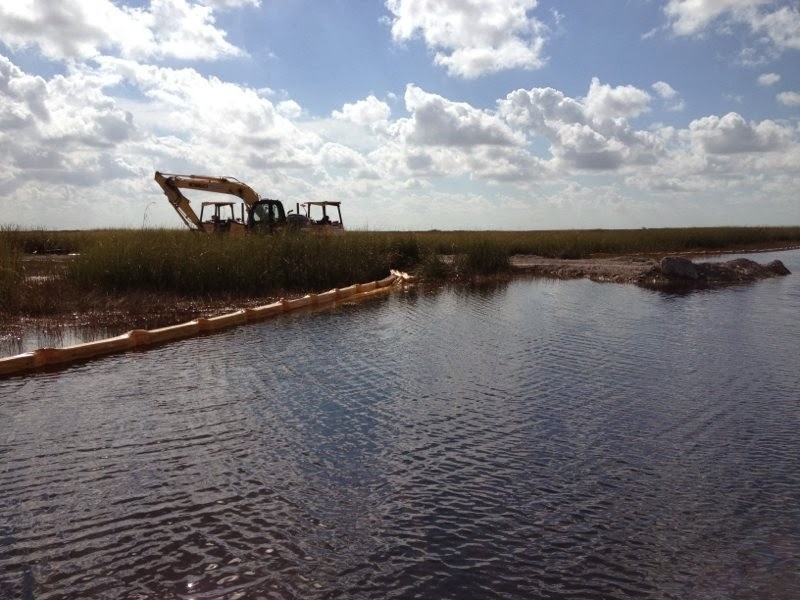
                Construction for the project about a year ago, and the lab I’m in has been collecting fish, amphibian, and aquatic invertebrate data since Fall 2010. Water is projected to flow east from a section of the Everglades known as Water Conservation Area 3A, through a series of culverts in the L67-A levee, across a roughly 1 mile section of marsh known as the “Gap” or “Pocket”, and then across the L67-C canal and levee into Water Conservation Area 3B. The C canal, where many of my field sites are, has either been filled in entirely or partially filled across the experimental zone. This will examine whether future restoration projects can get away with just partial canal fills, a much cheaper option than filling a deep canal with earth all the way to marsh level. The project is finally complete and today the culverts in the A levee were opened. Today, known to many in many agencies and institutions as “Flow Day”, is the first day in what hopes to be a great day for Everglades restoration.  I am amazed at how much manpower and collaboration goes in to trying to restore natural components of the Everglades landscape. And it’s certainly odd to spend so much time out here with no other humans (besides some very dedicated and excellent field technicians), and suddenly there’s a fleet of dump trucks and earth movers out in the middle of the Everglades! Well worth the effort though for this exciting (and necessary) project for restoration.
                I’ll post aerial photos within the next couple of weeks! Stay tuned! Photo credits go to Sabrina Schneider, one of those very excellent techs I spoke of.


Monday, October 28, 2013

Why do we still know so little about common species?

October 28, 2013 0

This guest post was written by James Stroud, Ph. D. student in Dr. Ken Feeley's lab at Florida International University.  He is a regular blogger on the Feeley lab blog upwithclimate.

-------------------------------------------------------------------------------------------------------------------------

South Florida is a wild place for lizards. And at the moment, as the region’s most abundant native lizard, life sucks for the American green anole Anolis carolinensis.

In the recent past a wealth of invasions have occurred from exotic Caribbean Anolis leading to the establishment of up to 10 non-native species around the Miami area, annually creeping further outwards towards the Everglades. The effect of congenerics on American green anoles has been well studied; the presence of an ecologically similar competitor – such as the now widespread Cuban brown anole Anolis sagrei (Fig. 2) – has forced them higher up into the trees and off the ground.


Fig 1. Range of the American green anole Anolis carolinensis in south-eastern United States. Different colours represent genetically distinct populations – from Campbell-Staton et. al. 2012.

However, the majority of these studies have been conducted in spatially explicit areas, that is to say on experimental islands. These have merits in themselves; it allows control of many assumptions which may skew your observations. For example, in continuous space one may expect species A to simply move away from species B if spatially out-competed, however islands offer the advantage of forced interactions meaning resource partitioning and habitat shifts may be more easily observed.


Figure 2. An adult male Cuban brown anole Anolis sagrei (Photo: J Stroud)

Isolated from all other Anolis since the pre-Pleistocene, the American green anole has had it pretty easy so far. They range from the southernmost tip of the USA, Key West, north to Tennessee, and west to mid-Texas (Fig 1). However the rapid range expansion of introduced species, pioneered by the previously mentioned Cuban brown anole, has caused the anecdotal decline of green anoles in the urban and suburban areas in south Florida. Whether this population decline is true, or a shift to arboreality has affected detection rates is unclear. What is clear is that the invasion by the exotic Anolis do not seem to be limited by habitat factors – yet.

Deep in the sawgrass plains of the Everglades the green anole still persists, for the time being at least, in allopatry. It’s ecology there is almost a complete mystery. Despite extensive research on the ecosystem, we know next to nothing about this species’ ecology here. Throughout the rest of its range a wealth of literature exists, however for populations in the Everglades we are still unclear on fundamental aspects of their ecology; habitat choice, diet, reproductive biology, sleeping sites or daily/seasonal activity patterns – all axes along which competitors may cause disruption.

And this is something that always puzzles me in ecological research – often we try to run before we can walk. Natural history is the basis of much of ecology, however in the present world of big science and meta-everything, this can often get overlooked.


Figure 3. For example, nectivory in American green anoles Anolis carolinensis is a relatively undocumented and still unstudied feeding behaviour whose implications are not well understood (photo: S. Koptur)

The potential ecological impacts of exotic anoles on the native green anole in the Everglades are unknown, and as it stands any hypothesis would be theoretical at best. However as scientists, we must remember that some of the greatest theories have arisen from natural observations. Where would evolution be without Darwin’s twitching?

Not only does the invasion expansion of Caribbean anoles present a native species conservation issue, but the potential for a large increase in terrestrial insectivores seems a topic of interest that should merit some thought for a wide range of ecologists. The Cuban brown anole is already present at every car park along the Everglades road to Flamingo, likely transported unwittingly via humans. How long we have before they begin to disperse may just be a question of time.

I encourage all of us that have the privilege to spend time outdoors in south Florida to collect as many field notes and natural history data as possible. In this world of change, the global scale effects of climatic events and warming remain unresolved, much like the more regionalised effects of human management. The importance of these data are clear, but often overlooked; they describe reality. So I return to my original question – with such a rich history of research in the Everglades why do we still know so little about the regions most charismatic lizard?