Showing posts with label Restoration. Show all posts

Thursday, March 20, 2014

My Recapture Story for the Everglades

March 20, 2014 0
The following link is to an article written by Jessica Lee, FIU graduate student in Dr. Jennifer Rehage's aquatic biology lab (http://www2.fiu.edu/~rehagej/index.html).
__________________________________________________________________________
     In February I had an opportunity to fish with my favorite group of anglers from the Keys. For the past 30 years this group of fishermen has faithfully made it every month to the backcountry to fish. They were the inspiration for the Coastal Angler Science Team (CAST), the “original-members” before CAST officially came to be.  For the past two years they have been regularly scanning their catches for “recaptures” (previous fish we tagged with internal microchips, “PIT-tags”).  This group alone has caught over 30 recaptures, about half of the current CAST totals.
To read more, please go to http://cast.fiu.edu/index.php/my-recapture-story-for-the-everglades/ .

Monday, October 29, 2012

Rising star in FCE

October 29, 2012 0
I would like to introduce you to a new rising star in the FCE, Sara Osorio! She has been working with FCE LTER Education and Outreach coordinator, Mr. Nick Oehm, and our lead PI, Dr. Evelyn Gaiser. Her research project is about the diatoms found in the wetland restoration area of the Deering Estate (Biscayne Coastal Wetlands Project).

Sara Osorio, FCE LTER High School Researcher at the FIU Periphyton Lab

Sara is currently a junior in high school. She became involved in FCE research because she was always fond of her science classes, including AP Biology. Through the recommendations of Mr. Oehm, Sara became one of our newest high school researchers.

Sara is working with Dr. Gaiser in the Periphyton Lab at FIU as a LTER high school research assistant, where she is receiving personal instruction on all the necessary aspects of a real scientific research study: field sampling, laboratory procedures, diatom identification, and microscopy. Later, there will likely be data analysis, poster making, and writing advice, too!

Through collaboration with the Deering Estate, Sara and Dr. Gaiser made a trek through the coastal wetland restoration area to collect periphyton samples across a fresh water to marine water transect. This area used to be the location of a mansion, as well as a Native American burial ground, now being rehabilitated to its natural state. Sara enjoyed the field sampling experience, as she has always loved to be out in nature, even though it required her to get a bit down and dirty (she made sure to wear old jeans that day). One part of the transect was full of hairy, slimey, filamentous algae - but even that could not stop Sara.

Sara sampling hairy, slimey, filamentous algae at the Deering Estate

Sara sampling with Chris Sanchez, FCE and CAP LTER undergraduate researcher

Sara learned how to process these samples in the lab. She remembers how cool it was to see the bubbling and foaming reaction of periphyton when you pour acid on them - a necessary step in cleaning samples for diatom identification.

Currently, Sara is learning to become an expert in microscopy and diatom identification. She says this step has been the most challenging part of her research experience so far because there are so many details on a diatom cell that you need to look at for identification. However, she thinks it is very cool to see things under the microscope that not many people get to see.

Pleurosigma, diatom identified and photographed by Sara
In the future, Sara aspires to continue her studies in biology. She is also keeping her options open for opportunities in the medical field, especially through the military services. Sara expresses her gratitude for the opportunities she has found through FCE, especially the personal guidance by a professor. She is a great example of how future scientists can get an amazing head start through scientific education and outreach programs. Not to mention, the Periphyton Lab is thrilled to have such a bright and motivated student working with us!

Sara sampling coastal periphyton with Dr. Evelyn Gaiser
Graduate students and PIs: There are amazing young scientists like Sara who are willing to work in your lab for free! Be sure to contact Nick Oehm if you are interested in having your own rising star.

High school and undergraduate students: Research experience is rare and looks extremely impressive on any college or graduate school application. Not only do you learn a lot, you also enter into a network consisting of your mentor and their colleagues. Their word of recommendation means a lot! Don't miss these opportunities!

Monday, September 17, 2012

Fish on the Move

September 17, 2012 0

Our full time bloggers are recovering from the FCE-LTER Beach BBQ this weekend so we've asked Mike Bush from the Department of Biology to talk about his research on fish movement in the Everglades.
---------------------------------------------------------------------------------------------------------------------------------------

Identifying patterns of animal movement is an important part of most conservation programs. As Everglades restoration continues, identifying how fishes respond to changes in water flow, removal of levees, etc. will provide us with important information about how restoration is changing the Everglades. I’m going to briefly discuss some of my work with large fish movement in the central Everglades.


Starting in May 2011 and continuing almost uninterrupted through today, I’ve been tracking two different fish species in an area known as the Gap (between Water Conservation Areas 3A and 3B). The fish are largemouth bass and bowfin, two big species that are common predators in the Everglades, gobbling up small fish and invertebrates as they patrol the marsh. I picked bass to study because they represent an important fishery in the Everglades, and few tracking days go by when I don’t have a discussion with bass fishermen about what I’m doing or Everglades restoration. Bowfin were chosen as the other species because they are a common predator, happily residing in both wide open canals and the thickest patch of sawgrass you can find. 

This study is a small piece of a very large project known as the Water Conservation Area 3 Decompartmentalization and Sheet Flow Enhancement Project (DPM). DPM is a multi-agency and institution effort designed to look at the effects that restoring flow patterns have on animals, plants, water retention, sediment transport…just about anything you can think of. I catch my fish by electroshocking (see Ross' post to learn more about electroshocking) via airboat.
Netting an electroshocked fish out of the marsh.  Surgery gear makes for a crowded boat!
Photo by Justin Dummit
Bass and bowfin get knocked out with an anesthetic, and then, as quickly and safely as we can, a technician holds down the fish upside down while I surgically implant a small radio transmitter near the fish’s gut.  The fish is then allowed to recover and is released near where we caught it.  The transmitter batteries last 4-6 months, and I try to find the fish on a weekly basis until the battery dies.  To date, 81 fish, about 40 of each species, have been implanted with transmitters. 

Implanting a radio transmitter into a largemouth bass.  Latex gloves are worn by the surgeon (myself) and iodine is applied to the incision post-surgery to keep conditions as sterile as possible.  Photo by Justin Dummit 
I’m still working on analyzing the data, but I can tell you that patterns are hard to identify!  Some fishes only move a matter of meters from week to week. Other fish move kilometers every week! Many fish do something in-between, where they might move a few kilometers every week, and then they seem to find a spot they like, a home range, where they only move a few dozen meters a week, usually focused around one slough. 

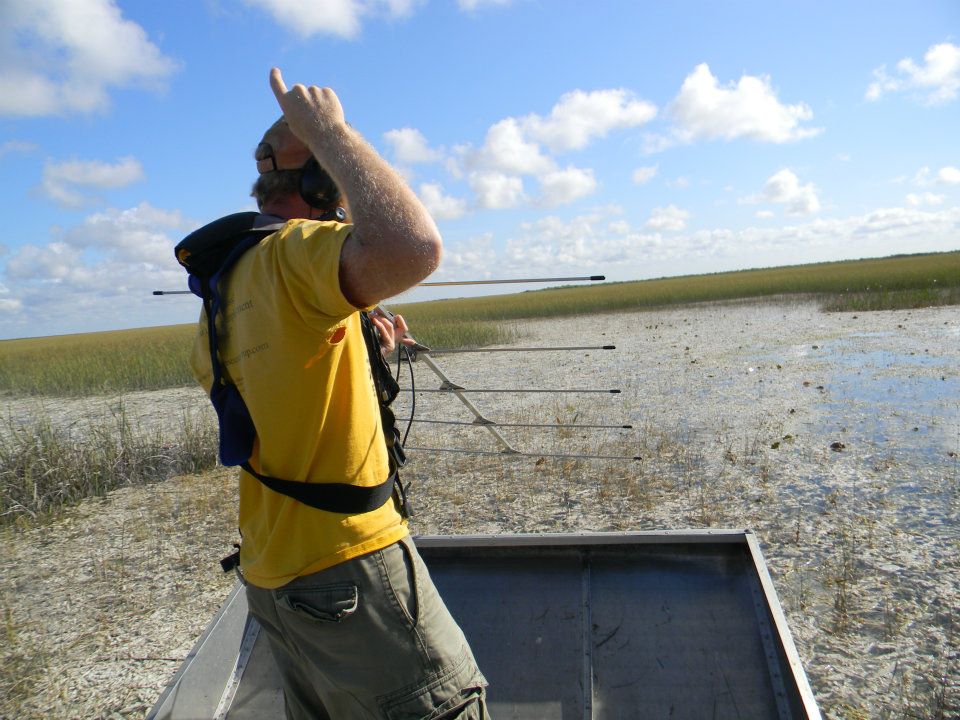
Telling the airboat driver to turn around in the marsh, probably right on top of a fish.
Photo by Hana Nardi
These patterns will be important to identify to let us know how these top-level predators are moving around the Everglades, and how restoration projects are affecting the important fishery they represent.  The culverts used to restore flow for DPM are set to open soon and I'll check back in with you then (with some cool construction photos) to give you updates on this project.

Mike Bush
Department of Biology
mbush002@fiu.edu