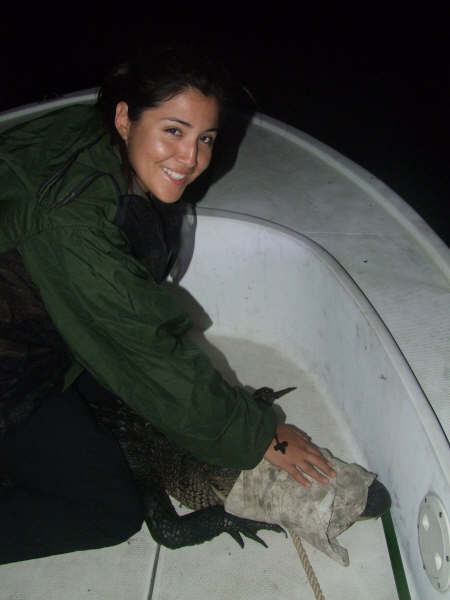
I would like to introduce you to a new rising star in the FCE, Sara Osorio! She has been working with FCE LTER Education and Outreach coordinator, Mr. Nick Oehm, and our lead PI, Dr. Evelyn Gaiser. Her research project is about the diatoms found in the wetland restoration area of the Deering Estate (Biscayne Coastal Wetlands Project).
Sara is currently a junior in high school. She became involved in FCE research because she was always fond of her science classes, including AP Biology. Through the recommendations of Mr. Oehm, Sara became one of our newest high school researchers.
Sara is working with Dr. Gaiser in the Periphyton Lab at FIU as a LTER high school research assistant, where she is receiving personal instruction on all the necessary aspects of a real scientific research study: field sampling, laboratory procedures, diatom identification, and microscopy. Later, there will likely be data analysis, poster making, and writing advice, too!
Through collaboration with the Deering Estate, Sara and Dr. Gaiser made a trek through the coastal wetland restoration area to collect periphyton samples across a fresh water to marine water transect. This area used to be the location of a mansion, as well as a Native American burial ground, now being rehabilitated to its natural state. Sara enjoyed the field sampling experience, as she has always loved to be out in nature, even though it required her to get a bit down and dirty (she made sure to wear old jeans that day). One part of the transect was full of hairy, slimey, filamentous algae - but even that could not stop Sara.
Sara learned how to process these samples in the lab. She remembers how cool it was to see the bubbling and foaming reaction of periphyton when you pour acid on them - a necessary step in cleaning samples for diatom identification.
Currently, Sara is learning to become an expert in microscopy and diatom identification. She says this step has been the most challenging part of her research experience so far because there are so many details on a diatom cell that you need to look at for identification. However, she thinks it is very cool to see things under the microscope that not many people get to see.
In the future, Sara aspires to continue her studies in biology. She is also keeping her options open for opportunities in the medical field, especially through the military services. Sara expresses her gratitude for the opportunities she has found through FCE, especially the personal guidance by a professor. She is a great example of how future scientists can get an amazing head start through scientific education and outreach programs. Not to mention, the Periphyton Lab is thrilled to have such a bright and motivated student working with us!
Graduate students and PIs: There are amazing young scientists like Sara who are willing to work in your lab for free! Be sure to contact Nick Oehm if you are interested in having your own rising star.
High school and undergraduate students: Research experience is rare and looks extremely impressive on any college or graduate school application. Not only do you learn a lot, you also enter into a network consisting of your mentor and their colleagues. Their word of recommendation means a lot! Don't miss these opportunities!
 |
| Sara Osorio, FCE LTER High School Researcher at the FIU Periphyton Lab |
Sara is currently a junior in high school. She became involved in FCE research because she was always fond of her science classes, including AP Biology. Through the recommendations of Mr. Oehm, Sara became one of our newest high school researchers.
Sara is working with Dr. Gaiser in the Periphyton Lab at FIU as a LTER high school research assistant, where she is receiving personal instruction on all the necessary aspects of a real scientific research study: field sampling, laboratory procedures, diatom identification, and microscopy. Later, there will likely be data analysis, poster making, and writing advice, too!
Through collaboration with the Deering Estate, Sara and Dr. Gaiser made a trek through the coastal wetland restoration area to collect periphyton samples across a fresh water to marine water transect. This area used to be the location of a mansion, as well as a Native American burial ground, now being rehabilitated to its natural state. Sara enjoyed the field sampling experience, as she has always loved to be out in nature, even though it required her to get a bit down and dirty (she made sure to wear old jeans that day). One part of the transect was full of hairy, slimey, filamentous algae - but even that could not stop Sara.
 |
| Sara sampling hairy, slimey, filamentous algae at the Deering Estate |
 |
| Sara sampling with Chris Sanchez, FCE and CAP LTER undergraduate researcher |
Sara learned how to process these samples in the lab. She remembers how cool it was to see the bubbling and foaming reaction of periphyton when you pour acid on them - a necessary step in cleaning samples for diatom identification.
Currently, Sara is learning to become an expert in microscopy and diatom identification. She says this step has been the most challenging part of her research experience so far because there are so many details on a diatom cell that you need to look at for identification. However, she thinks it is very cool to see things under the microscope that not many people get to see.
 |
| Pleurosigma, diatom identified and photographed by Sara |
 |
| Sara sampling coastal periphyton with Dr. Evelyn Gaiser |
High school and undergraduate students: Research experience is rare and looks extremely impressive on any college or graduate school application. Not only do you learn a lot, you also enter into a network consisting of your mentor and their colleagues. Their word of recommendation means a lot! Don't miss these opportunities!