Showing posts with label Alligator. Show all posts

Thursday, October 10, 2013

August Shark Sampling

October 10, 2013 0


This guest post was written by Phil Matich, a graduate researcher in Dr. Mike Heithaus' lab at Florida International University.
 _________________________________________________________________________

 We just got back from an amazing trip in August!  As always, we left early in the morning and were fortunate enough to catch the tail end of the Perseid meteor shower as we drove to the boat ramp.  On our way to the field site we saw the sun rise over the water and the mangroves, and then got right to work catching sharks.  On the first live, we caught two sharks, 79 and 85 cm total length, and surgically implanted the smaller individual with an acoustic transmitter so that we could track its movements.  Surprisingly, the larger shark was an individual we had caught and tagged in July, and is one of the first sharks we’ve recaptured in the last three years! 
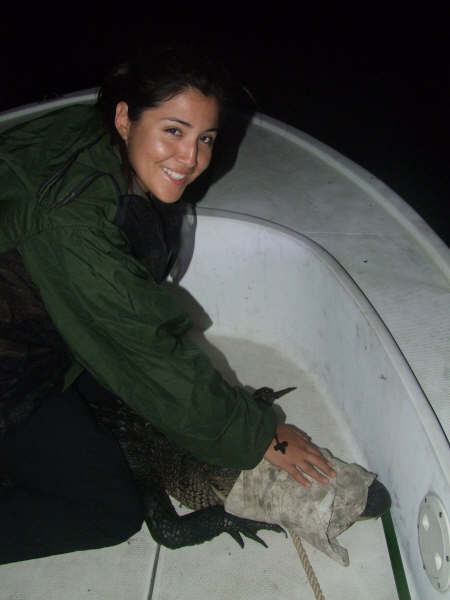
After only a month, the shark has grown 2 cm and gained 1 kg in body mass; the scar from the surgery has completely healed, and one of the sutures had already dissolved, and the other marks from tissue collections were healing (see the picture of the fin clip).  On the second set, we caught three more sharks (74, 81, and 104 cm TL), and acoustically tagged the 81 cm TL shark to track its movements.  After only a few hours on the water he had caught five sharks and deployed two transmitters!  On the third set we caught another shark (104 cm TL), and had a surprise on the line - a 2 meter alligator, which is the first gator we’ve caught after >3000 longline hooks deployed in the estuary.  It was pretty skinny and very docile, so it was probably sick and in poor condition and just looking for an easy meal.  We cut the line and the hook that was stuck in its mouth will rust out in the next month or so - I wasn’t going to reach my hand in to try and get it out.  Overall, it was an awesome day!  And, we got to hang out with a dolphin for a little while on the ride back.  I’m looking forward to more days like this in the future.


Thursday, January 3, 2013

What's in a name?

January 03, 2013 0
I've always been fascinated with the names of places and the history behind those names. Why is Paris called Paris, and why did somebody in Texas feel the need to use the name again? Why is the big rock in the middle of Australia called Uluru by the native Aboriginals and why did a white guy rename it Ayers Rock in the 19th century? The coastal Everglades is full of fantastically obvious (Mud Lake) and wonderfully enigmatic (Willy Willy) place names and I have bumped into many of them during my research. Here is a list of some of those places and where the names come from (or at least where I think they come from):

1. Shark River: There are sharks in it, though they are not easy to find sometimes.

2. Coot Bay: For many years I had no idea how this bay got its name or what a coot even was, then one day while driving through it early in the morning I saw a flotilla of water birds (at least a couple hundred strong) sitting together on the bay. They turned out to be coots from the genus Fulica. Case closed.
Coots. Photo Credit
3. Whitewater Bay: The name of this bay is obvious to anyone who has ever been there because whenever anything stronger than a light wind picks up, the bay becomes a playground for small to medium-sized waves (called whitecaps). If you look off in the distance on a windy day the water looks like it is completely white, meaning you are in for a bumpy boat ride.

4. Tarpon Bay: There are tarpon in it.

5. Rookery Branch: A highly reticulated branch of the Shark River that used to contain large numbers of wading bird rookeries (breeding sites). Sadly, the bird populations in this area have been greatly diminished by over-hunting and habitat alterations.
Everglades rookery. Photo credit
6. Ponce de Leon Bay: Named for Juan Ponce de Leon, the 16th century Spanish conquistador and first European to set foot in Florida. He was killed in 1521 by the Calusa tribe when they shot him in the leg with an arrow coated with poison from the manchineel tree.
Juan Ponce de Leon. Photo credit
7. Aaron Cut and Derek Cut: These are the names my lab came up with for the Shark River after it forks into two rivers as you head northeast towards Tarpon Bay. On my first day in the Everglades in 2007 my former labmates Derek and Aaron were on the boat with me, and Derek was driving. As we approached the fork, Derek asked Aaron "Which fork should I take?" Aaron said "Well, they both pretty much go to the same place, but the one on the left is wider and straighter, while the one on the right is narrower and much curvier. I prefer the left fork." Derek promptly took the right fork.

8. Flamingo: This park ranger station used to be an outpost settlement that ferried supplies to the Keys. It also used to be a rest stop for migrating flamingos. Now it's just the mosquito capital of the United States.

9. Pa-Hay-Okee: Seminole name for the Everglades, meaning "grassy water."

10. Harney River: Named after Colonel William Harney, who led American soldiers into battle against the Seminoles during the 19th century.

11. Gunboat Island: Small island in the Shark River shaped sort of like a gunboat. A little bit of a stretch.

12. Lard Can: Apparently the name of this campsite is derived from the habit of early gladesmen (alligator hunters, moonshiners, bird hunters) storing food and water supplies in empty 5 gallon lard cans at this site. Now I want to know what water with a hint of lard tastes like. Probably like watery lard.
Lard Can campsite. Photo credit
If anybody thinks any of this information is wrong, please post corrections in the comments.

Thursday, November 1, 2012

What's next?

November 01, 2012 0
What's next?
I'm just going to go ahead and say it: graduate school is great (though The Simpsons disagree). We're given 2-9 years (depending on whether you're a masters or doctoral student and the scope of your research) to live in a cozy academic bubble surrounded by like-minded peers doing research on things we think are interesting and important. We teach, we write, we think, we analyze, and we get to explore new places and meet really smart people. We don't have tons of extra responsibilities like kids (usually) and onerous administrative crap, and we're given some room to fail every once in a while (the most important part of the scientific process). Sure graduate school can be frustrating, annoying, and just plain idiotic at times, but that's pretty much a definition for life. Let's not get bogged down in the mundane. But the question I've been asking myself recently is, what's next?


What comes after graduate school? I'm planning on graduating with my PhD next summer and there are a whole lot of decisions that need to be made and time that needs to be managed efficiently. Here's a brief synopsis of my scientific to-do list for the next nine months: Finish writing my dissertation (5-6 chapters, likely somewhere north of 200 pages when all said and done), try to publish each of those chapters in scientific journals (two down, 3-4 to go), continue networking and building collaborations with other scientists to expand my future research opportunities, and apply for multiple post-doctoral research positions and hope that one comes through.

This last bit represents a very interesting part of the multi-faceted scientific life: we have to always be looking forward and backwards at the same time. For example, I am currently writing two brand spanking new research proposals for two different post-doctoral opportunities while at the same time writing papers based on my alligator research that is already complete. Half my time is spent looking back at the research I've done, trying to make sense of it and fitting it into the current scientific discourse, while the other half of my time is spent trying to get funding to do future research and predict what kinds of scientific questions are going to be important over the next few years. It's not like this is unique to me (all scientists do this) but as a young scientist it's still quite a challenging balancing act.

Also, I have to start thinking about what the "goal" of all this is (as if there is a concrete one out there somewhere). After my post-doc, do I want to try and get a job as a scientist with the state or federal government? What about an environmental NGO? Or a job applying science to public policy? Or a job at a university, and if so, what kind of university? Some of these options require different kinds of post-doc experience, so choosing the "right" post-doc can have big implications for your career path. I've attended lots of job panels at science conferences around the country where scientists from all the different job sectors come together and talk about what their jobs are like, how to get a job in their field, and on and on. The message from each panel has been clear: it is not always easy to switch from one type of scientific career to another once you've started down a certain path, so do the legwork now to set yourself up for the type of career you want. That is, if you know what type of scientific career you want.

Through this whole convoluted process I've found encouragement from some advice given to me by a man I met in Belize many years ago: I was 18 and working on a research project studying manatee ecology and behavior off the coast of Belize City. One day we went out to a coral reef to track manatees and do some spear fishing for our dinner, and while we were swimming around a huge catamaran pulled up near our little boat. I swam over to the boat to see who was on board and was warmly greeted by a wealthy middle-aged California businessman on vacation with his wife. They invited me on board for a little lunch and a Coke and we talked about science and the randomness of meeting people anywhere at anytime. During the conversation he said to me "You want to know the secret to success? To how I got where I am today? It's staying open to possibilities. Never close yourself off to new things and new people, and pursue new opportunities as they come your way. Take risks and see what happens. There are no wrong choices, just different ones." Good advice I think.


Thursday, October 11, 2012

Toto, I don’t think we’re in Kansas anymore!

October 11, 2012 0

Guest post today from a new member of the FCE community!
--------------------------------------------------------------------------------------------------------------------------
Howdy ya’ll! I’m one of the newest members of the Trexler lab, here all the way from Houston, Texas. I finished my Masters in May, which focused on reproductive life histories of small stream fishes. In addition to working in some amazing clear water East Texas streams, I have a love/hate relationship with springs in the beautiful West Texas Chihuahuan desert. But, life hasn’t all been unicorns and butterflies; I’ve worked in my share of dumpy freshwater sites. However, nothing prepared me for what I was to endure in the Everglades. 


Don’t get me wrong, I am in no way suggesting that the Everglades are “dumpy,” but rather mysterious and frankly, comedic. This past summer I was lucky enough to (literally) get my feet wet in the Everglades. I was excited, yet terrified. In Texas, alligators eat people… or so the story goes. I envisioned myself on this amazing airboat ride, only to get my calf taken out by a man-eating reptile. My first trip to the glades was with Mike Bush, who suggested I “shuffle my feet” to avoid gators. Seriously Bush?! I doubt “shuffling my feet” is going to keep a gator from eating me!! Anyway, he may or may not have been right, but I did not encounter nor become the dinner of an alligator. Day two was much more eventful; it was pouring rain and I had no rain gear. We were setting up drift fences made of 32 lbs of rebar (this may be a slight exaggeration) and I somehow managed to step in every chin-deep hole in the Gap (area between Water Conservation Areas 3A and 3B) while carrying these fences. My waders were filled with water/mud, the rain was freezing and I had a soggy pb&j for lunch. If you can believe it, I came back for thirds. 

Setting up drift fences.  Photo courtesy of Eric Fortman.


After a couple of interesting trips, I discovered the beauty and elegance of this system. In particular, Shark River Slough and Taylor Slough were some of the most amazing sites I've seen to date. The sheer size of this ecosystem is astonishing and the more I learn about its flora, fauna and ecology, the more intrigued I become; I have even learned to befriend (but respect) the gators! I am extremely lucky to have the opportunity to work in the country’s most prized restoration project. I guess Marjory Stoneman Douglas had it right- “it reveals its secrets slowly…” After traveling to almost every corner of this amazingly diverse ecosystem, I came to a couple of conclusions: 1) The Everglades are amazing, and 2) The Gap must be part of the ‘Truman Show’ and Mike Bush is the main star. 

Photo courtesy of Eric Fortman.


Jessica Sanchez
Doctoral Student
Florida International University
Department of Biological Sciences
jsanc318@fiu.edu

Thursday, October 4, 2012

Why I love alligators

October 04, 2012 0
I've always had a passion for animals, particularly large animals of the dangerous variety (big predators), but before I started my PhD I had never really spent much time thinking about alligators. Now, after working with alligators in the coastal Everglades for the past 5 years, they are one of my favorite animals. Let me tell you a few reasons why:

1. Alligators can get really big. The largest alligator officially recorded in Florida from 1977-1993 weighed in at 1041 lbs. Alligators can get so big that they can take down adult deer, like in this picture taken in Georgia by Terri Jenkins, a US Fish and Wildlife Service district fire management officer. The gator in this picture is "only" 12-14 ft. long.


2. Alligators can change their digestion rates. Alligators eat large meals (like whole deer) fairly infrequently, so it's to their advantage to be able to slow down their metabolism when they have nothing in their stomach to save energy. However, when they do eat a large meal, it's to their advantage to digest it quickly so their movement isn't hindered by having lots of meat sitting in their stomach slowing them down. The way that alligators ramp up their digestion is really cool: they have a "shunt" in their heart that they can shut off, forcing carbon dioxide rich blood (which would normally go to the lungs to allow the carbon dioxide to be exhaled) to the stomach, where that carbon dioxide gets turned into gastric acid and helps break food down rapidly.

Alligator heart (Photo credit)

3. Alligators breathe like birds. It's not exactly clear how they do this, but a study showed that alligators breathe unidirectionally, similar to the way birds breathe. Mammals (like us) breathe bi-directionally or "tidally," with air coming in to our lungs, then stopping and being forced out in the opposite direction through the same pathway. Alligators and birds, in contrast, have respiratory systems that allow air to enter their lungs through one pathway but then leave through a different pathway, meaning air always moves in one direction through their respiratory systems. It's thought that this unidirectional system is more efficient at extracting oxygen from the air and shows that alligators and birds are quite closely related.

4. Alligator immune systems are ridiculous. During my field research I've encountered many alligators missing part of their tails or even whole arms or legs, yet most of these individuals seem perfectly healthy. How is it that an alligator that gets in a fight with another alligator, ends up with a gaping wound, and still has to  live in a swamp filled with bacteria, viruses, and parasites doesn't get incredibly sick? It turns out that the alligator immune system is 10 times more effective at killing off bacteria than the human immune system and that alligators can mount immune defenses against 3 times as many strains of bacteria as humans can. Some researchers are currently looking into ways of exploiting these powerful antibacterial properties of alligator immune systems for human benefit.

5. Alligators eat fruit sometimes! Most people think of alligators as strict carnivores, but I've found through stomach contents analysis that alligators in the coastal Everglades eat lots of pond apples (Annona glabra), a less than tasty fruit that most humans don't like. I also worked with some colleagues to research other kinds of fruits that crocodilians have been documented consuming and we found records of 46 different fruits in crocodilian stomachs. We don't know if they eat the fruits intentionally or just because they are curious animals and will put anything in their mouths, but it's an interesting phenomenon none the less.

6. Alligators can move far and fast. Alligators are typically thought of as slow-moving animals that laze around sunning themselves for most of their lives, but my movement studies paint a more nuanced picture. Back in 2007, in collaboration with Frank Mazzotti of the University of Florida, we attached GPS transmitters to two alligators in the Shark River Estuary. Over the next 146 days, one of the alligators moved a total of 801.5 km, an average of 5.5 km per day! Furthermore, the longest distance traveled in one 24 hour period was 22.4 km, and the fastest speed recorded was 2.9 km/hr. However, over 58 days the other alligator only moved 8.7 km total, an average of 0.15 km per day. I guess some alligators really like to explore and see the world, while other alligators like to stay home and watch TV.

An alligator with a GPS transmitter attached to its neck (the white blob with the antenna sticking out).
All of these adaptations put together (plus many others) are the reasons why crocodilians have been so successful over many millions of years. They are incredibly adaptive animals that can live almost anywhere that freshwater exists in the tropics and sub-tropics, they can move long distances to find food and mates and improve their living conditions, they can save energy when food is scarce but take advantage of big meals when they do come around, they almost never get seriously ill, they have efficient respiratory systems, and they can grow very large so that other animals can't hurt them. They are truly amazing creatures and I feel very lucky to have the opportunity to study them.

For further reading, check out:

Farmer C, TJ Uriona, DB Olsen, M Steenblik, K Sanders (2008) The right-to-left shunt of crocodilians serves digestion. Physiological and Biochemical Zoology 81:125-137

Farmer C, K Sanders (2010) Unidirectional airflow in the lungs of alligators. Science 327:338-340

Merchant M, C Roche, RM Elsey, J Prudhomme (2003) Antibacterial properties of serum from the American alligator (Alligator mississippiensis). Comparative Biochemistry and Physiology, Part B 136:505-513

Woodward A, JH White, SB Linda (1995) Maximum size of the alligator (Alligator mississippiensis). Journal of Herpetology 29:507-513


Monday, August 27, 2012

Preparing the next generation

August 27, 2012 0
One of the great joys of science, in my view, is teaching others about science, how it works, and why it is arguably the most advanced type of problem solving ever invented by humans. As graduate students at FIU we are given ample opportunities to pass along our knowledge, expertise, and love of science to the next generation of scientists (undergraduates) through teaching classes, giving public lectures, and directly mentoring individual students. At last count FIU had about 40,000 undergraduates enrolled, so finding motivated students to help out with graduate research is a relatively easy task.


After five years in FIU's biology PhD program, I've had the pleasure of mentoring eight students for various lengths of time (six FIU undergrads, one Ursinus College undergrad, and one Miami-Dade high school student). They've assisted me with data entry, data analysis, lab work, literature research, and even field work in the Everglades, including alligator catching.

In return, besides the amazing hands-on learning experiences, the undergraduate students can receive research credits from FIU that count towards their graduation requirements. They also get great reference letters from me when they apply for internships or for admission to graduate school. The Miami-Dade high school student I mentored last year, Jamie Odzer, even entered the research she did with me into the International Science and Engineering Fair and won 3rd place in her category, receiving $2,000 in prize money!

Jamie Odzer
Watching and participating in the maturation of young scientists is extremely enjoyable for me. Their enthusiasm for animals or lab techniques that you've dealt with hundreds of times is infectious and helps remind you that your research is exciting and worthwhile, and they enable you to see the amazing process of science through fresh eyes again. If you are an undergraduate or high school student reading this and you want to be involved with science in any way, get in touch with labs at a university or college near you and ask if you can volunteer on a graduate research project. The experience will be life changing for you and your mentor.


Greg Mineau
Cynthia Aceves
Fernanda Velasco


Jenn Meyer
Melissa Pimentel


Max Lowenstein

Tuesday, July 31, 2012

What the inside of an alligator smells like

July 31, 2012 0
Ever wonder what an alligator's breath smells like? One of the perks of my research is I get to hang out within sneezing distance of the amazing reptiles and I can tell you from first hand experience that their breath smells like death. Two of the major questions I try to answer with my research is what do alligators eat in the coastal Everglades and where do they eat it? To get at these questions, I use two different techniques: stomach contents analysis (SCA) and stable isotope analysis (SIA).


For SCA, me and my team catch alligators at night using high powered spotlights and steel snares attached to long poles. Once an alligator has been caught and its mouth taped shut, we bring it up on board our boat, strap it to a long wooden plank so it can't move, place a PVC pipe into its mouth to hold it open, and then thread a tube down its throat and into its stomach. The other end of the hose is attached to a water pump which we use to fill the gator's stomach with water, and then we use a modified Heimlich maneuver to force the water and anything floating in it out of the gator and into a bucket (check out a video of this process here). It may sound like a rough experience for the gator, but it's very similar to how humans get their stomachs pumped at a hospital. Also, in the old days alligator stomach contents could only be gathered by killing the animal and then cutting its stomach out of its body, so our technique is obviously much more preferable.


I've found that alligators eat a wide variety of different foods, including blue crabs, anhingas, rice rats, mink, anchovies, catfish, pond apples, and even non-food items like string and balloons. Alligators are very curious animals and will basically eat anything they can fit their mouths around.

Pieces of blue crab, anhinga, and shrimp pulled out of a gator's stomach.
SCA gives us information about what kinds of animals alligators ate over the past two or three days, but to get a sense of what they eat over longer time periods I use SIA, a technique that uses complex machines to determine the chemical components (like carbon and nitrogen) of animal tissues. Different animals and different food webs can exhibit different types of carbon and nitrogen, and we can use the relative abundances of these different types of elements in animal tissues to get an idea of where they've been feeding and when. By using SCA and SIA together I can get a better overall picture of how alligators fit into the coastal Everglades food web, and this information will be very useful to Everglades ecosystem managers as they figure out how best to restore the Everglades to what it once was.

Friday, July 6, 2012

Camping in the Everglades

July 06, 2012 0
To study American alligators that live in the coastal Everglades you need to be a bit of a night owl. Alligators are much easier to find and catch at night because their eyes glow bright red when you shine a spotlight at them, whereas during the day they blend in amazingly well with the water and the vegetation because of the sleek, low profile of their bodies. Fortunately for me, my natural sleep patterns involve staying up late and waking up around noon.


Even with the natural advantages of my sleep patterns, this type of research is easier to carry out if you camp out in the Everglades because you can quickly crash in your tent after a long night of alligator wrestling rather than making the long haul back to shore. Everglades National Park provides a surprisingly large number of great camp sites for researchers and fishermen to use. One type is called a "chickee," which is a very simple wooden platform that sits on stilts above the surface of the water.
Photo credit 
The chickees are generally clean and comfy (as long as you bring an air mattress), and sleep is aided by the sounds of the water gently lapping at your platform and the night calls of the frogs and birds.

There are also campsites that have been cleared out of the middle of mangrove islands. Our lab's Everglades research team frequently stays at one called Cane Patch because it can accommodate a large number of tents and has lots of space to move around in.

The disadvantages of staying at a campsite rather than a chickee surrounded by water is that you open your supplies up to invasion by rats and you can get a scare from the occasional rattlesnake, but on the plus side you have space to build a small fire so you can dry your clothes after the skies open up and drop buckets of rain on you.

After doing alligator research in the coastal Everglades for 5 years, camping out at my study site is now one of my favorite things to do. The sunsets and sunrises are superb in the swamp, and the stars at night aren't washed out by the neon lights of Miami. When the moon is full and the sky is clear, it can feel as bright as daytime, and the alligators are just waiting for me to find them.