Monday, March 26, 2018

Long Dissertation Short

March 26, 2018 0
I am passionate about science communication, and I try to come up with accessible ways to present my research to the public. I know that my research is important and work hard to share its value with others beyond academia. I also know that many of my fellow graduate students are also committed to scientific outreach. I am not expert in science communication yet. However; I have sought opportunities to advance my science communication skills. I have plenty of advice to other graduate students looking to do the same, so I am going to write a series of blog posts explaining how I have translated my research to the public and what opportunities are available.
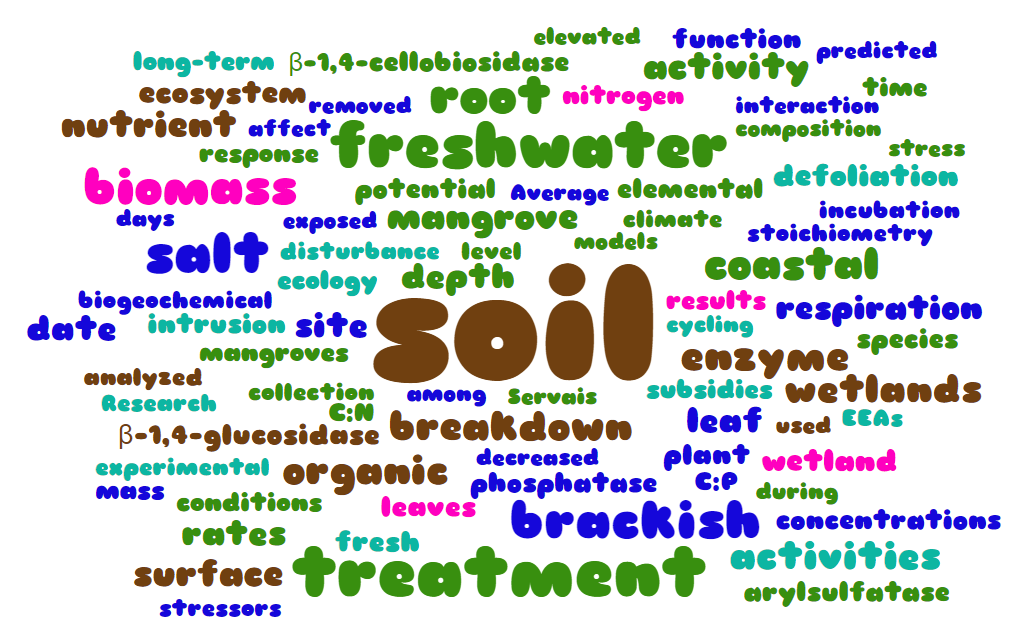
Shelby Servais' dissertation summarized in a word cloud.
Here is the first and most simple; I created a word cloud with the top used words in my dissertation. I think the dissertation is necessary to communicate the findings of your research in an academic setting. However, it is probably the least accessible format for the public. The word cloud I generated is a simple overview of the key terms in my research. For reference, I used the word soil 612 times! Basically, this word cloud shows the most common terms I use to describe my work. I study soil microbes and how their functioning is altered when exposed to changing environmental conditions. From this word cloud, I can begin to identify potential jargon that might need to be eliminated or defined for a non-academic audience. Additionally, the summary of terms provided by the word cloud helps me synthesize the focal points of my dissertation.

I would love to see your work in a word cloud! If you have written a proposal, manuscript, dissertation, or even completed your written exams try and make one yourself. Send me (sserv005@fiu.edu) the word cloud for your project and a brief description of your study, and it will be featured on the blog.


Tuesday, March 13, 2018

Hurricanes and Social-Ecological Systems: What Climate Change Means to Both

March 13, 2018 0

Post by: Luke Lamb-Wotton
 
A satellite image from the 2017 Atlantic season. Pictured are Hurricanes Katia (left), Irma (center), and Jose (right). Credit: Wikimedia Commons.  


For all of us living in coastal areas susceptible to high-energy storms, we all know too well the mayhem and devastation that can be associated with major landfalling hurricanes (category 3+). It took me a mere 3 months living in South Florida to experience my first run-in with one of these wicked storms. 

On September 10th, 2017, after Hurricane Irma swept through Cuba and prompted a mandatory evacuation order for the Florida Keys, Irma came screaming towards South Florida, originally predicted to make a direct hiton Miami-Dade but opted (to Miami-Dade’s relief) to take a more south-westerly track towards Tampa Bay. Regardless of the exact track, Irma’s expansive wind-field and storm surge still wreaked havoc on Miami-Dade’s infrastructure (some images can be found here), contributing to Irma’s ranking as the 5thcostliest U.S. hurricane on record, as reported by NOAA’s National Hurricane Center, reaching an estimated $50,000,000 in damages. 

In general, the 2017 Atlantic hurricane season was one for the record books, ranking 7th in terms of annual U.S. hurricane activity. Beginning August 27th, the U.S. got hit with the 30 dayhurricane three-piece as Hurricane’s Harvey, Irma, and Maria made landfall, the first Atlantic hurricanes to do so since Hurricane Wilma in 2005. Hurricane Harvey brought devastating rainfall to Houston, ranking by one weather historian as, “the most extreme precipitation event to hit a major U.S. city.” Hurricane Irma broke a whole slew of records- including the world record for time maintained at peak intensity (185 mph). Irma also leveled the island of Barbuda, which may force Barbuda into the modern world, as told by the Washington Post. Last but not least we can’t forget about Hurricane Maria, the storm that ransacked the Caribbean and started a national discussion about the speed of the ongoing federal hurricane relief. 

While it is easy to start pointing fingers and proclaim, “it’s climate change”, we need to be careful with these words (a lesson I surely learned during Dr. Joel Trexler’s Advanced Ecology course). A quick Google search makes it evident that the hurricane-climate change discussion is a hot topic. So, what do the experts think?

Two reports, one from NOAAand the other from NASA, generally conclude the same, and can be summarized succinctly with a quote from the NOAA report (linked above):

A future increase in tropical cyclone precipitation rates is likely; an increase in tropical cyclone intensity is likely; an increase in very intense (category 4 and 5) tropical cyclones is more likely than not; and there is medium confidence in a decrease in the frequency of weaker tropical cyclones.”

Yikes! The above quote likely sounds alarming to those who live within hurricane affected areas but one point should be clarified: this is referring to changes in globalhurricane activity and trends at global-scale often aren’t applicable at smaller spatial scales, a trap I often fall into in my research.
In that same NOAA report, the authors explain that little correlation between greenhouse gas emissions and hurricane activity exists for Atlantic basin hurricanes over the 120+ years of record. If a change in activity is to occur in the Atlantic basin, it likely wouldn’t even be detectable until the latter half of the century.

So, what to make of all this? When hurricane activity is aggregated across all the different basins of activity, increases in activity and intensity are very likely, but basin specific changes will be variable. While it is difficult to discern regional variability, preparing for the worst-case scenario might not be a terrible idea. 

In a 2005 paper, Adger et al. describe what they call social-ecological resilience to natural disasters and use case-studies to show how some regions exhibit more resilience than others. The authors define resilience in this usage as, “the capacity of linked social-ecological systems to absorb recurrent disturbances such as hurricanes and floods so as to retain essential structures, processes, and feedbacks.”

Adger and colleagues go on to describe an example of how varying levels of social-ecological resilience in South and Southeast Asia led to some areas being disproportionately affected by the 2004 Asian tsunami, caused by the second largest earthquake ever recorded. Contrary to what one might think, islands with high-levels of local knowledge and preparedness survived and were returned to some sort of normalcy faster than some mainland areas. 

While it is a good strategy to think about social resilience to natural disasters, some of the leaders in the field of Urban Ecology recently applied a conceptual framework to describe disturbance events and their impacts on “social-ecological-technological systems” (Grimm et al. 2017). 

By applying model specifications for describing disturbance events in urban settings, urban practitioners can focus their efforts on improving the resilience of their respective urban settings by identifying outcomes and vulnerabilities based on a standard set of criteria (Grimm et al. 2017). This is an important step in the right direction towards minimizing the catastrophic nature of hurricanes on cities and societies in an era of global increases in hurricane activity.

While I know that I have two paragraphs above discussing social-ecological resilience, one point I did want to make was that it was refreshing to see Grimm et al. make a focused effort on defining the entirety of the disturbance event without framing the discussion with a “let’s build resilience” narrative. While it is an important topic to consider (one of the first words you see when going to FIU’s Sea-Level Solutions Center webpage), it strikes me as an overused framework.
While I don’t mean to say “resiliency” is a bad framework in and of itself when discussing these issues. However, it seems to me that it could be perceived by some that by “building resilience” to climate change related events means climate change isn’t here yet and it most certainly is.

The complexities of society are only going to increase in an age of globalization and it would appear that hurricanes (and other natural disasters), will increase as well. Since certain regions will be better equipped than others to deal with this, I’d like to leave y’all with one final thought: As a global society, I think we can all agree that we still have a ways to go in figuring out how to distribute pockets of regional resilience across all parts of this spinning rock we call Home.

References
1.      Direct link to NOAA report: https://www.gfdl.noaa.gov/global-warming-and-hurricanes/
2.      Adger, W. Neil, et al. "Social-ecological resilience to coastal disasters." Science 309.5737 (2005): 1036-1039.
3.      Grimm, Nancy B., et al. "Does the ecological concept of disturbance have utility in urban social–ecological–technological systems?" Ecosystem Health and Sustainability3.1 (2017).

Wednesday, February 28, 2018

The Nightmare of Networking

February 28, 2018 0


We live in a reality where getting a graduate degree does not mean you are automatically qualified for a job. In fact, according to a recent NSF study, 42.1% of 2014 PhD graduates reported no definite job commitments at the time of graduation. This number is a bit debated but we all know recent grads who sent out hundreds of applications and were forced to take whatever job they could get. Want a tenure track job? An industry position? A place in the government? You will send out tens if not hundreds of applications to these positions and hear nothing back, but it’s not necessarily because you are not qualified. Jobs like these are not a dime a dozen these days, and employers get so many applications that no matter how good your resume looks you are likely to get looked over. So how do you get your name to the top of the pile? You probably already know the answer: make yourself known. Network with the right people at the right time and make sure they remember you. You’ve heard it before, the proverbial “it’s all about who you know”. Easier said than done though.

Let’s face it, we scientists are an inherently awkward bunch. Many of us are shy, introverted, or just not comfortable with walking up to strangers and introducing ourselves. Even if you are an uncommon social butterfly, the idea of networking with potential employers can be daunting. As a second-year PhD student who has completed a master’s degree I have learned quite a bit about networking do’s and don’ts. I won’t claim to know everything, but I certainly feel a lot more confident about networking than I did as an undergraduate. In this post, I hope to share some of the tips and tricks I have picked up along the way that will hopefully help you turn the nightmare of networking into something a little less frightening.


Rule #1: Attend Conferences Whenever You Can

I recommend picking a conference that is specific to your field and is as big as you want your job search to be and attend it every year. Really want to stay local in the future? Maybe you have family in the area or your spouse has a great job. Pick a small state-specific conference. Not too picky about where you end up? Go national. Really want to broaden your horizons and get a post-doc somewhere abroad? Choose an international conference that is often located in other countries.
           
Now you may be thinking, conferences are expensive! Yes, they are but as a student you can easily go to at least one conference for free every year. Your department should have student travel funding you can apply for and the graduate school at your university may as well. These are likely small sums of money, like $200-300, but when you add them up they really help. Also, most conferences offer student travel grants or volunteer opportunities. You can usually volunteer for a few hours at the meeting and they will pay for your registration. If you are proactive about it, there is plenty of travel money to be found. And if you have a free ride to a conference, your advisor is not likely to keep you from going.

Rule #2: Don’t Just Attend a Conference, Be a Part of It

Whether you are almost finished your degree or just starting out, you should always present at any meeting. Even if you just have some vague project idea, put it on a poster. You never know what kind of advice you might get. If you are close to finishing and looking for a job, a poster is a great place for you to tack up business cards or a CV. If there is a session that is super relevant to what you are doing consider giving an oral presentation. That way you know most of the people interested in the topic will be there.

You don’t need to attend every single oral presentation; your brain won’t be able to handle it. But do make sure you go to every single social event. It may seem counter-productive to go out to the bar instead of practicing your talk or catching up on emails, but it is crucial. The best networking is always done in a relaxed, social atmosphere! On that note, make sure to get the people you do know to introduce you to the people you don’t. Your advisor and the postdocs and older graduate students in your lab probably know a good chunk of the people at the meeting. That whole seven degrees of separation thing? Chances are you know someone who knows someone who knows that super awesome scientist you’ve been dying to meet.

Rule #3: Follow Up With All the People You Meet

This is the part that I will admit I am not so great at. We tend to go to our conferences, meet all these awesome people, and then come home and forget all about them while we focus on our busy graduate student lives. But keeping in touch with people is super important. You never know who will be working for a company you are really interested in, or who might be hiring in the future. Imagine how awesome it would be if you could call one of those people up and say hey, we met at this meeting blah blah blah, I hear you are hiring?? The best way I’ve found to keep in touch with people is to get their business cards and then when you go home look them up on LinkedIn, Research Gate, twitter, etc. This is the age of social media after all so use it to your advantage! You might not feel comfortable emailing someone you met for 2 minutes to say hey, remember me! But, you can follow what they are doing, keep track of their publications, and if they follow you back you will pop up on their social media feeds. Win, win.            

Rule #4: Have Fun!!

For some reason networking is this super scary word that makes us want to run and hide. But it’s actually not that scary at all. Networking is really just making friends with people in your field. Making friends is fun! 


You might think meeting those two other graduate students from another institution doesn’t count as networking but it definitely does. You don’t just have to network up (with professors, professionals, etc.), networking across (with other grad students), or down (with undergraduates) is just as important. You never know where people will end up in 5-10 years and that intern that helped you with the boring lab work for your project may very well be the next Albert Einstein. Ok, maybe that’s a stretch but you get the picture. Take advantage of every opportunity to go to a conference or workshop and make the most of it. You may think you are too busy to take a week off from your project, but it will be more than worth it when it comes time to apply for jobs. In the words of an African Proverb I just found on the internet: “If you want to go fast, go alone. If you want to go far, go with others.” 🌟